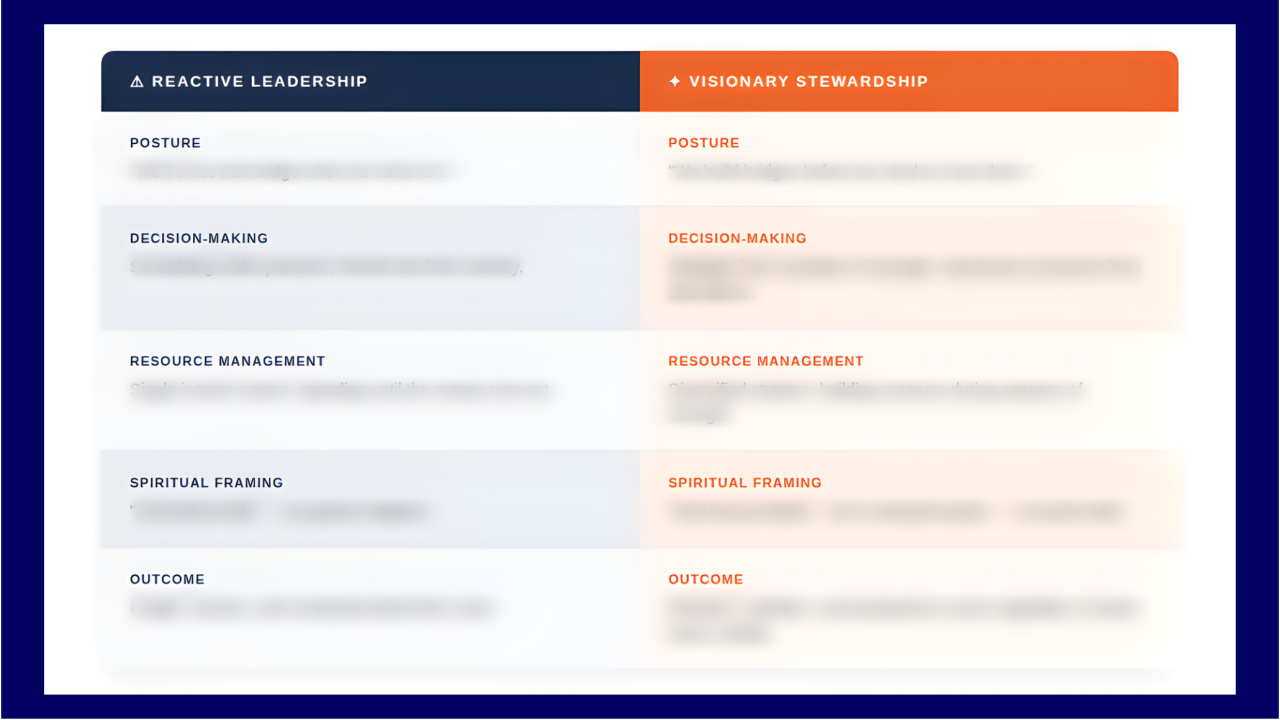
Reactive Leadership vs. Visionary Stewardship for Pastors
by Erin Ward, ChurchReady Co-Founder
There's a question pastors rarely ask out loud, but carry quietly into every budget meeting, every elder board conversation, every Sunday as the offering plates pass.
"Are we actually prepared for what's coming?"
You're not imagining the unease. Giving patterns are shifting. Younger members face job instability that would have been unthinkable a generation ago. Economic disruption that used to unfold over decades is now happening in years, and AI-driven automation is accelerating the pace.
You're not alone in feeling this. And you're not behind for asking the question. The fact that you're asking it is itself a mark of pastoral faithfulness.
But here's what matters now: not just that you sense something is changing, but how your church is positioned to respond. The conversation about AI and the future church isn't theoretical for most pastoral leaders anymore. It's showing up in the giving report, in the pastoral care conversations, in the way budget planning feels harder than it used to.
And that comes down to a fundamental leadership choice, one that determines whether your church will be scrambling when pressure arrives, or whether you'll already be standing on solid ground.
It comes down to the difference between Reactive Leadership and Visionary Stewardship.
Two Paths. Every Church Is on One of Them.
Reactive Leadership isn't a character flaw. It's a default mode, the natural human tendency to deal with problems when they arrive rather than prepare for them in advance. Most of us lead this way in at least some areas of ministry. It looks like waiting until giving drops before examining the budget. Addressing operational inefficiencies only when burnout becomes a crisis. Thinking about financial diversification only after the endowment runs dry. Treating economic uncertainty as someone else's problem until it lands on your doorstep.
Reactive Leadership isn't necessarily a failure of faith or intelligence. Often it's simply a failure of margin, the tyranny of the urgent crowding out the wisdom of the important.
Visionary Stewardship is a different posture entirely. It's the practice of building resilience before you need it, preparing from strength rather than scrambling from weakness. It holds two things simultaneously that our culture often treats as opposites: faith in God's sovereignty and prudence in stewarding the resources He's entrusted to us.
These are not competing values. They are the whole counsel of Scripture held in creative tension. And they describe the kind of leadership the Church needs right now.
Joseph Didn't Wait for the Famine
The most instructive picture of Visionary Stewardship in Scripture isn't found in a business book or a leadership conference. It's in Genesis 41.
Joseph, standing before Pharaoh, didn't simply identify the threat. He analyzed Egypt's existing capacity, optimized a systematic response during the years of plenty, and maximized what was available so thoroughly that Egypt not only survived the famine but became a place of provision for surrounding nations.
Notice what Joseph did not do. He did not wait until the famine arrived. He did not say, "God will provide. We'll figure it out when the time comes." He named what was coming and stewarded wisely in response.
Proverbs 22:3 captures this principle in a single line: the wise see danger and take refuge, while the simple keep going and pay the penalty. This is not a call to anxiety. It is a call to stewardship, to leading your congregation with eyes open, not eyes closed.
Joseph's foresight didn't reflect a lack of faith. It reflected faith in action. And the result was not just survival. Egypt became a place of refuge for surrounding nations in their time of need.
That is what Visionary Stewardship can do for your church. Not just survive the pressures ahead, but become a place of strength and refuge for a community that will need what only the Church can provide.
5 Signs Your Church May Be on the Reactive Path
Most churches don't choose Reactive Leadership intentionally. They drift into it. These patterns are worth recognizing, not as indictments, but as diagnostics. Awareness is the first movement toward change.
1. Budget Conversations Happen Only When There's a Problem
If your leadership team only reviews financial health when giving dips, you're operating reactively. Visionary stewards review the condition of their flocks regularly, not in crisis mode, but as an ordinary practice of faithful oversight (Proverbs 27:23).
2. Your Church Has One Primary Revenue Source
If Sunday morning giving represents more than 80 to 90 percent of your annual operating budget, you have a concentration risk that most financial advisors would flag immediately. Visionary Stewardship means building margin across multiple streams, not out of distrust in generosity, but out of wisdom about how economies work.
3. You're Waiting for "More Data" Before Preparing
Some pastors are waiting for clearer proof that AI job displacement will affect their congregation before making any changes. The wise leader of Proverbs 22:3 doesn't wait until the danger arrives. If you're ready to start with a clear picture of where your church actually stands, the Church Resilience Assessment at churchready.org is the right first step.
4. Your Team Is Running at or Near Capacity
When staff burnout is your baseline, your church has no margin to respond to anything new, including economic shifts that demand strategic adaptation. Visionary Stewardship includes operational efficiency not just as a budget measure, but as a ministry sustainability measure. Exhausted teams cannot lead resilient churches.
5. Your Ministry Vision Assumes the Economy Stays the Same
If your multi-year plan is built on the assumption that giving will grow at historical rates, you're planning for a world that current economic trends suggest may not materialize. Visionary stewards plan across multiple scenarios: gradual change, rapid disruption, and relative stability. building infrastructure that serves the mission regardless of which future unfolds.
This Isn't Fear. It's Faithful Leadership.
Let's be clear about something: preparing your church for economic uncertainty is not an act of anxiety. It is not a failure of faith. And it is certainly not a concession that God is not in control.
Joseph's faith in God's sovereignty didn't prevent him from analyzing, optimizing, and maximizing what Egypt had. The wise builder of Matthew 7 wasn't expressing doubt when he dug deep to lay his foundation on rock. The owner who entrusted his servants with talents in Matthew 25 expected active, faithful stewardship, not passive waiting.
Visionary Stewardship holds both truths simultaneously. God is sovereign, and we steward wisely. We plan as if it depends on us. We pray as if it depends on God. These are not opposites. They are two hands of faithful Christian leadership.
What distinguishes Visionary Stewardship from fear-driven preparation is its source. It doesn't start with panic about what might happen. It starts with clarity about what we've been entrusted with and a genuine desire to protect the mission, for the congregation we serve, for the community that needs the Church, and for the generation that will inherit whatever foundation we build today.
Which Path Is Your Church Actually On?
The honest answer for most churches is: somewhere in between. You're not fully reactive, and you're not fully equipped as a Visionary Steward. That's not a failure. It's a starting point.
The question isn't whether you've already arrived at resilience. The question is which direction you're moving.
Carey Nieuwhof's AI and the Future Church is beginning to name what church leaders are already sensing about the scale of this shift. The awareness it creates is valuable. What comes after the awareness is where ChurchReady operates: the concrete, staged work of building resilience while you still have capacity to build from strength.
Visionary Stewardship doesn't happen all at once. It unfolds progressively, each step building on the last, each one moving your church from vulnerability toward capacity. And it begins not with a grand plan, but with a clear picture of where you actually are.
If you've read this and recognized yourself more in the Reactive Leadership pattern than you'd like to admit, you're in exactly the right place. Recognition is how every meaningful change begins.
Preparing from Strength, Not Scrambling from Weakness
The best time to build resilience is during the years of plenty. Joseph knew this. The wise builder of Matthew 7 knew this. The servant who invested his talents rather than burying them knew this.
Visionary Stewardship is not a hedge against a future you're afraid of. It's an act of faithfulness toward the congregation and community you've been entrusted to serve, whatever economic conditions arrive.
The church's mission doesn't change when the economy does. But the infrastructure that sustains that mission needs to be built for the economy that's actually coming, not the one that existed a decade ago.
You don't need to have all the answers before you move. You need a clear picture of where you are. Take the Church AI Readiness Assessment and in 10 minutes you will know where your church stands and what to address first.