Pastoral Burnout and AI and the Future Church: The Hidden Leadership Crisis
by Erin Ward, ChurchReady CEO | Co-Founder
The conversation about AI and the future church almost always looks outward - at the economy, the culture, the congregation walking in the door. This one looks at the person who has to carry all of it.
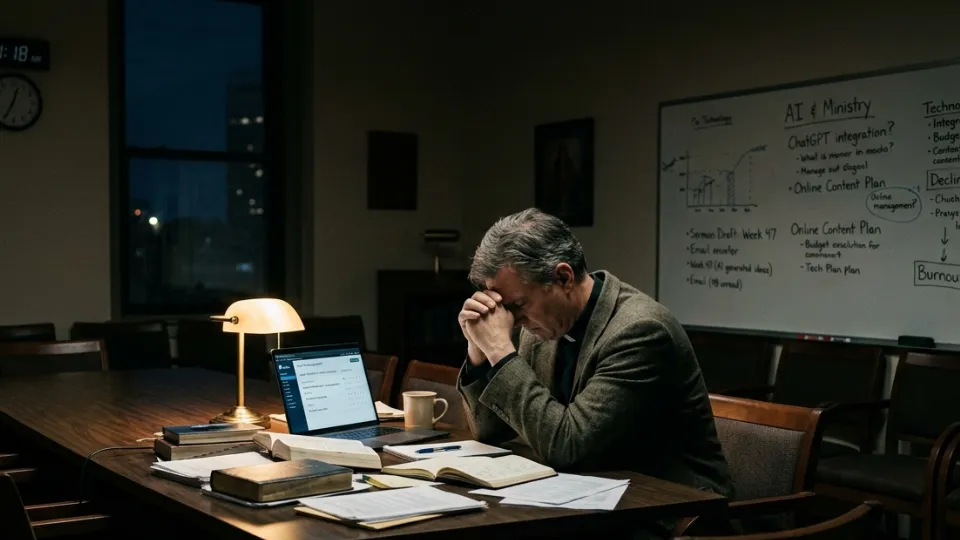
There's a pastor I know who's been in ministry for nineteen years. He doesn't talk about it much, but in a conversation last fall he said something I've been sitting with since. He said, "I spend so much of my week helping people figure out who they are without their jobs, and I'm starting to wonder who I am without mine."
He wasn't planning to leave. He loves the work. But something had shifted in him, quietly, over years of absorbing everyone else's disorientation. The congregation's anxiety had become his own, and he'd run out of the inner margin to process it.
That conversation comes back to me every time I see new data on pastoral health. Because what he described isn't just fatigue. It's something more specific and more serious.
The Weight Pastors Are Already Carrying
Barna's most recent research shows that while the percentage of pastors considering leaving ministry has eased from a pandemic-era high, one in four still seriously contemplates walking away. Between 2015 and 2023, the share of pastors who describe their mental and emotional health as excellent dropped from 39 percent to 14 percent. Those who report having true friendships fell by nearly half.
Let's take a closer look at what those numbers mean. The people responsible for holding a congregation together through loss, uncertainty, and transition are themselves experiencing the kind of relational and emotional depletion that makes sustained leadership nearly impossible. The pastoral care infrastructure is strained at precisely the moment it's being asked to carry more.
This is the flame that was already burning before anyone started talking about AI. Leadership fatigue. Vocational isolation. The slow erosion of the inner life that good ministry requires. These aren't new problems. They've been building for years, and most churches have addressed them only at the margins.
What Arrives on Top of an Already Burning Flame
Now consider what AI-driven economic disruption is bringing into that same pastoral context. The question of AI and the future church runs through the pastoral care office before it runs through the budget meeting. For a large and growing portion of the congregation, work isn't simply an income source. It's identity, structure, community, and purpose. When those roles disappear or transform through automation, the grief that follows doesn't announce itself as grief. It looks like withdrawal. Flatness. A quiet loss of direction the person can't quite name.
That's what's coming through the door now. For many workers, especially those in white-collar and middle-management roles most exposed to AI displacement, the loss of a career can trigger a grief process as significant as a major relationship loss, without the social permission to grieve it openly. There are no rituals for losing your job to a machine. There are no community structures designed to hold that kind of disorientation. Except, potentially, the church.
Which means the pastor who is already running on empty will increasingly be asked to help people navigate a category of loss that pastoral training hasn't prepared them for, at a volume the current infrastructure can't absorb.
A Framework for What's Happening
There's a concept in organizational psychology called the emotional labor tax: the cumulative cost of consistently managing your own emotional state to meet the relational demands of your role. For pastors, that tax has always been high. What current trends suggest is that it's about to increase significantly.
When congregants are navigating identity loss at scale, when the workforce disruptions that current economic trajectories point toward begin reaching the families who sit in your pews on Sunday, the demand on the pastor as grief counselor, identity anchor, and meaning-maker will intensify. The research is clear: without intentional structural support, that intensification doesn't make pastors stronger. It depletes them.
The pastor I described at the beginning wasn't unusual. He was early. What he was experiencing in isolated pockets of his congregation is now expanding. And the economic conditions driving it aren't slowing down.
Here's the question we should ask. Barna's recent State of Church Tech findings add a layer that sharpens the urgency: only 12 percent of pastors feel comfortable teaching their congregation how to navigate AI's impact on their lives. That gap between what's coming and what the pastor is prepared to address isn't a small gap.
Why This Moment Is Different
Churches have always absorbed economic hardship. Congregations have navigated recessions, industry collapses, and regional downturns before. What makes the current trajectory different isn't the presence of disruption. It's the nature of it.
Previous economic pressures displaced workers in specific industries or regions. The current wave of AI-driven displacement is moving across sectors simultaneously, affecting administrative, professional, and creative roles that have historically been recession-resistant. The people experiencing this most acutely are often the same people who serve on boards, lead small groups, tithe consistently, and form the relational backbone of a congregation.
And the grief they carry doesn't look like prior economic hardship, because the cause is harder to name. When a factory closes, the community grieves together. When automation absorbs a role quietly over eighteen months, the loss is private, diffuse, and often accompanied by shame. The pastor who hasn't thought about how to hold that specific kind of loss won't know what they're encountering when it walks through the door.
What Proverbs 22 Understood
Proverbs 22:3 reads: the wise see danger and take refuge, but the simple keep going and pay the penalty. That word prudent in the original carries the sense of shrewdness and foresight, seeing what is approaching before it arrives. The contrast isn't between brave and cowardly. It's between those who see clearly and those who don't.
The wise pastor isn't the one who avoids difficulty. It's the one who looks honestly at what's coming, assesses their current capacity against it, and builds the structural margin and support that will allow them to lead through it rather than under it. That's not anxious preparation. It's wisdom that serves the congregation.
Carey Nieuwhof's AI and the Future Church is raising the right questions about what's coming. What the pastoral health data adds to that conversation is the internal dimension: the leaders being asked to shepherd congregations through AI-driven disruption are themselves experiencing the cumulative strain of years of under-supported ministry. Both realities need to be named, and both need to be prepared for.
What Survives Is Not Heroism. It's Infrastructure.
The pastors who will lead their congregations well through what's coming aren't the ones with the most natural resilience. They're the ones who will have built the systems, the support structures, and the operational clarity that allows them to give without depleting.
This is what Visionary Stewardship looks like when applied to pastoral health. Not waiting for burnout to signal a problem. Building the infrastructure for sustainable leadership now, while there's capacity to do it. The mission doesn't need leaders who collapse in year seven. It needs pastors who are still standing in year twenty, still genuinely present, still capable of holding the weight that's coming through the door.
That kind of leadership isn't a personality trait. It's a practice. It's built. And it starts with an honest picture of where you stand right now.
An Honest First Step
If anything in this post named something you've been carrying quietly, that recognition matters. It's the beginning of honest leadership. The question is what you do with it.
The Church Resilience Assessment gives you a clear picture of where your church stands across the dimensions that determine sustainable ministry, including the operational and structural factors that either support or undermine long-term pastoral health. It's free and takes less than ten minutes.