The Cost of Waiting to Prepare for AI and the Future Church
by Erin Ward, ChurchReady Co-Founder
The Honest Reason Pastors Wait
When I ask pastors whether they've thought about how AI is already reshaping their church's budget and the faith lives of the people in their pews, I hear a version of the same answer. I know it matters. I just don't have the time right now.
That sounds like a scheduling problem. Underneath the busy calendar, what I actually hear is that church AI readiness feels like a whole separate challenge to most pastors, one competing for the same hours as everything already on their plate: giving pressure, burnout, generational transition, the normal weight of leading a congregation. Something has to lose that competition, and AI readiness usually does.
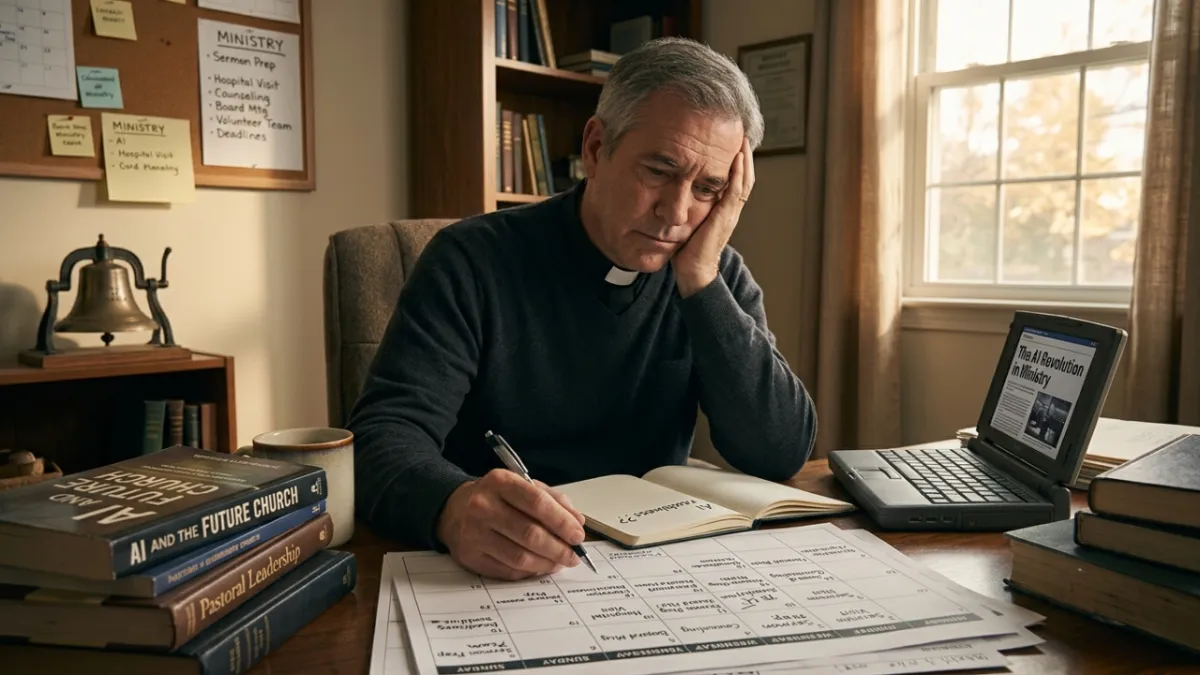
Here's an average week. After Sunday's sermon gets delivered, Monday it starts over again. There's a hospital visit that can't wait, a counseling session that runs long, a board meeting that needs prep, a volunteer who quit without notice, and three emails that all say "when you get a chance." Everything on that list has a deadline.
What's Already Happening Without a Decision Behind It
AI readiness doesn't have a deadline yet. That's why it keeps losing, and it's also the problem, because AI itself isn't waiting for a quieter week. Staff and volunteers in most churches are already using it for sermon prep, communications, and administrative work, whether or not anyone made a decision about that on purpose.
Barna's most recent research on pastors and AI found that only 13 percent say they don't use it in their ministry work at all. The adoption already happened. What most churches haven't done yet is decide where the lines are.
This matters for a specific reason. AI-generated content sounds confident whether or not it's accurate, and a sermon note, a pastoral email, or a piece of counseling advice that sounds right but isn't doctrinally sound can reach a congregation before anyone catches it. The real exposure is that nobody decided in advance what the tool is and isn't allowed to touch.
The Pastor's Own AI Readiness Gap
There's a name for this specific gap, and it's different from the other pressures competing for a pastor's week. We call it the Pastor's Own Readiness Gap: the distance between how much AI has already entered a church's daily operations and how much structure exists around that use. It measures whether the person leading a congregation has closed the space between using a tool and governing it, before the congregation ever asks the question.
This gap doesn't show up the way a giving shortfall or an attendance drop does. Nobody flags it in a board meeting. It just sits underneath the ordinary use of AI for sermon prep and emails, quietly, until something surfaces it: a piece of AI-generated content with a theological error nobody caught, a volunteer who wasn't sure what was appropriate and guessed wrong, a question from a congregant nobody had prepared to answer.
Church AI Policy Nobody's Written Yet
This isn't the same kind of gap pastors have managed before. Ministry has always involved learning new tools without a manual. What's different here is the speed at which the tool moved from optional to embedded, and the fact that congregants are already forming their own views about AI, with or without pastoral input.
Barna Group's research found that one in three practicing Christians want guidance from their pastor on how to think about AI, and only 12 percent of pastors currently feel comfortable teaching on the subject. That gap doesn't close on its own. It means a congregation is already forming its own thinking about AI somewhere else, at the exact moment many of them are asking their pastor for help with it.
That gap persists mainly because of hours. Lifeway Research found that half of pastors say they need to focus on time management, and more than half describe avoiding over-commitment as a genuine, ongoing struggle. Every one of those hours is already spoken for before AI enters the conversation at all.
Books like Carey Nieuwhof's AI and the Future Church are helping name this reality for a wider audience, and that matters. Naming a gap and closing it are two different projects. The first can happen in a chapter. The second happens inside a church, one written decision at a time.
None of this requires a pastor to become a technologist, and it doesn't require months of research before anything gets written down. A short, honest survey of what staff and volunteers are already doing with AI, followed by a simple written position on where the lines sit, closes more of the gap than most pastors expect. Waiting for a perfect policy is its own version of the same problem: a well-intentioned delay that keeps losing to whatever has a deadline this week.
The Weight Underneath the Calendar
Underneath all of this sits something every leader feels, not only pastors. The fear of failing the people who trust you. The longing to lead from clarity instead of catching up from behind. Nobody wants to be the one explaining, after the fact, why nothing was in place when it mattered.
That weight follows a pastor into every board meeting, every hospital room, every Sunday morning that starts the whole cycle over again. AI readiness is simply the newest item asking for space in a week that has none to spare.
Proverbs puts a fine point on this kind of moment: the prudent see danger coming and take cover, while the simple keep walking and pay for it later (Proverbs 22:3). It's a verse about timing, about paying attention early enough that the response stays a choice instead of a scramble forced by circumstance.
Two Ways This Plays Out
None of this is a verdict on the pastors carrying it. Most already care about using AI well. Most already sense where the gaps sit. What's missing is infrastructure: a written position, a decision about where the lines are, a way of knowing what's actually happening across a staff and a congregation instead of assuming it. This is what happens when a technology moves faster than the formal preparation for addressing it, in a role that was already full before AI arrived.
Caring about the outcome and knowing where a church actually stands are two separate things, and only one of them can be verified. A pastor can care deeply about using AI faithfully and still have no written policy, no clear answer ready for a volunteer who isn't sure what's appropriate, no real picture of how many congregants are already turning to AI for spiritual guidance or company. Good intentions are the right starting point. Knowing whether a church's actual systems protect what a pastor intends is what makes those intentions operational.
There are really only two ways this plays out for AI and the future church in most congregations. One is that the gap keeps losing to whatever already has a deadline, until a crisis, a mistake in front of the congregation, or a policy question nobody had an answer for forces it onto the calendar at the worst possible time. The other is that a church takes one clear-eyed look at where it actually stands before that happens, on its own schedule, with time to respond well instead of react.
That second path starts small: one honest look at what AI is already touching in day-to-day operations, what a congregation may already be carrying, and where the real gap sits between using the tool and governing it. Nothing about that first look requires solving everything at once.
Where Your Church Actually Stands
The first step is knowing where you stand. Take the Church AI Readiness Assessment at churchready.org. It's free, it takes less than ten minutes, and it will show you exactly what to address first, even on a week that has no room left in it.