AI and the Future Church: Why Clarity Comes Before Action Matters
by Erin Ward, ChurchReady Co-Founder
Most pastors already know AI is changing their church. Almost none of them have measured how.
That's not the same as being unaware. In our conversations with pastors, the ones who feel most behind on AI and the future church are often the ones who've done the most reading. They can explain what artificial intelligence is doing to jobs, to giving patterns, to the way people process grief, belonging, and truth. They've read the articles. They've listened to the podcasts.
Ask them how many households in their own congregation carry AI-related job risk, or whether their own staff is already using AI every week with nothing written down about what's appropriate, and the room goes quiet.
The AI and Church Governance Gap Most Pastors Haven't Measured
That's the pressure underneath all of this, and it's an old one wearing new language: a pastor's week has no margin left in it. Sunday's coming. So is the board meeting, last month's budget shortfall, and the volunteer who just quit. Reading about AI fits into a week like that. Sitting down to find out exactly where your own church stands does not.
On top of that sits something newer, and it isn't the one most pastors expect first. This time it sits closer to home than job loss in the pews: how far AI has already moved into a pastor's own operations, sermon prep, communications, pastoral care follow-up, while almost nothing has been decided about how it should be used.
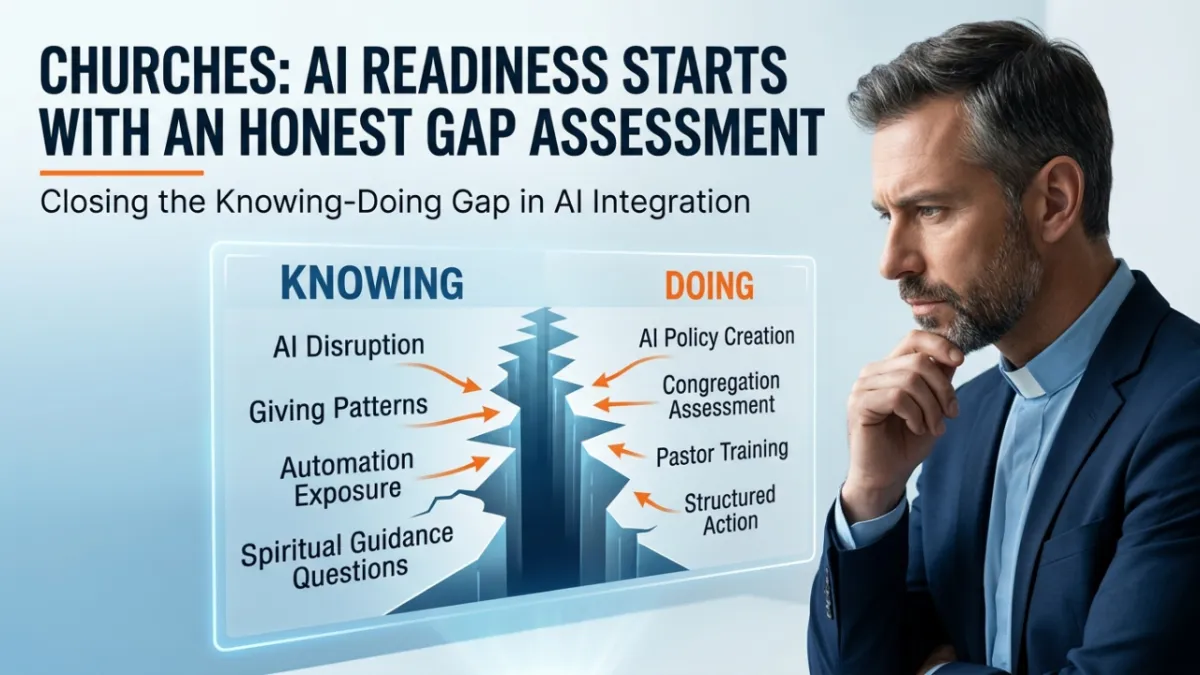
Organizational researchers have a name for the general pattern. They call it the knowing-doing gap, the well-documented tendency to accumulate more knowledge about a problem than anyone acts on, because knowing feels like progress and acting requires a decision. It shows up in hospitals that know the hand-washing protocol and skip it anyway. It shows up in churches that know AI is already inside their walls and have never sat down to ask exactly where.
What makes this particular version of the AI and the future church conversation worth naming right now isn't the theory. It's the specifics, and getting specific means naming what actually needs measuring. Not just the budget line, though that matters. The full picture: which systems and processes already touch AI, and what your own congregation is quietly carrying, including how many households already face AI-related job risk and how many people in your pews already trust AI for spiritual guidance more than they'd say out loud. The 2026 State of AI in the Church Survey, conducted by Exponential AI NEXT and ChurchTechToday.com, found that 93 percent of church leaders are already engaging with AI in some form. The same survey found that 73 percent of churches have no AI policy at all. Most churches already using AI weekly, for sermon help, for communications that go out under the church's name, are doing it without ever deciding together what's appropriate.
Closing the Pastor AI Readiness Gap Before the Questions Arrive
That's the policy side of the gap. There's a comfort side too. Barna's research found that a third of practicing Christians want guidance from their pastor on how to think about AI, while only 12 percent of pastors feel comfortable teaching on it. The people most hungry for pastoral guidance on this are largely not getting it, not for lack of care, but because most haven't yet had reason to build a framework for addressing it publicly.
None of this is a verdict on any pastor's leadership. Most are already using these tools personally, in good faith, without training in how to think about them from the front of the room. What we consistently see is that pastors already recognize the right questions. What's missing is the infrastructure to answer them before they arrive: a written policy, a simple review step for AI-assisted content before it reaches the congregation, a clear sense of who on staff is already using these tools and would welcome guidance rather than figuring it out alone. Books like Carey Nieuwhof's AI and the Future Church are beginning to name what a lot of church leaders are already sensing but haven't said out loud. That conversation matters. It's naming the awareness. Closing the gap is a separate task, and it's the one most churches we work with haven't started.
Underneath all of it is something every leader recognizes, whether they lead a church, a team, or a household. Nobody wants to spend limited time and energy solving a problem that turns out to be the wrong one. I've been part of ministry teams that made exactly that mistake, mistaking motion for progress because nobody had stopped to look first.
The deeper longing underneath the diagnosis is simpler than any of this sounds. It's the desire to lead from a place of knowing rather than guessing, to walk into the next hard conversation, whether it's with a board, a spouse, or your own conscience, standing on what's actually true instead of what you assumed was true because you hadn't checked yet.
Proverbs puts words to exactly this tension: "Even zeal is no good without knowledge, and he who hurries his footsteps misses the mark" (Proverbs 19:2). That's a warning against zeal that hasn't stopped to look first. Energy and good intentions moving ahead of clarity won't get a church ready for what AI is already changing in its budget, its operations, and the faith and lives of the people in the pews. It tends to take a church further in the opposite direction.
What Faithful Leadership Builds Before the Crisis Arrives
So what actually holds?
Not certainty about which AI scenario plays out over the next several years. Nobody has that. What holds is staying faithful to the mission while being honest about what's already changing around it.
Skip the work of getting clear, and a church tends to build new ministry efforts on assumptions instead of data, spend energy solving problems that were never the real ones, and make decisions from a general sense that something's off rather than a specific one. Do the work, and a church knows exactly where it stands, financially and operationally, can name specific gaps instead of a vague feeling of exposure, and walks into the next board meeting with something more solid than good intentions.
We've written more fully about AI and the future church and the trust problem running underneath both the financial and human sides of this disruption; this post is about the piece closest to home.
Good intentions are the right starting point. But intentions alone don't verify whether your church's actual systems reflect them: whether the guidelines your staff could actually produce if asked exist anywhere but in someone's head, whether a review step catches a doctrinal error before it reaches the congregation. A guideline nobody can produce when asked is the same as no guideline, and that includes whether your team would recognize an impersonation attempt today.
The same honesty applies on the congregational side. A short, anonymous survey, just a handful of questions about who's already facing AI-related job risk and who's already turning to AI for spiritual guidance or company, tells you something real instead of a guess. Skip that piece, and a church can complete every other part of getting ready while still carrying a real gap in what it actually knows about its own people.
This is what faithful stewardship looks like in practice: not scrambling to catch up once a gap becomes a crisis, but building readiness while there's still margin to build it. That starts smaller than it sounds. A short, honest look at what your team is already doing with AI. A basic written policy, even an imperfect one. A simple way to review AI-assisted content before it reaches the congregation. None of it requires a pastor to become a technologist. It requires deciding, on purpose, what the church's own position is before the congregation starts asking.
You don't need to have all the answers today. You need a clear, honest picture of where your church actually stands, and what to look at first.
That's exactly what the Church AI Readiness Assessment is built to give you. In about ten minutes, it will show you where your own readiness gap sits right now. Take the Church AI Readiness Assessment.