One in Three Churches Won't Be Here in Twenty Years | ChurchReady
by Erin Ward, ChurchReady Co-Founder
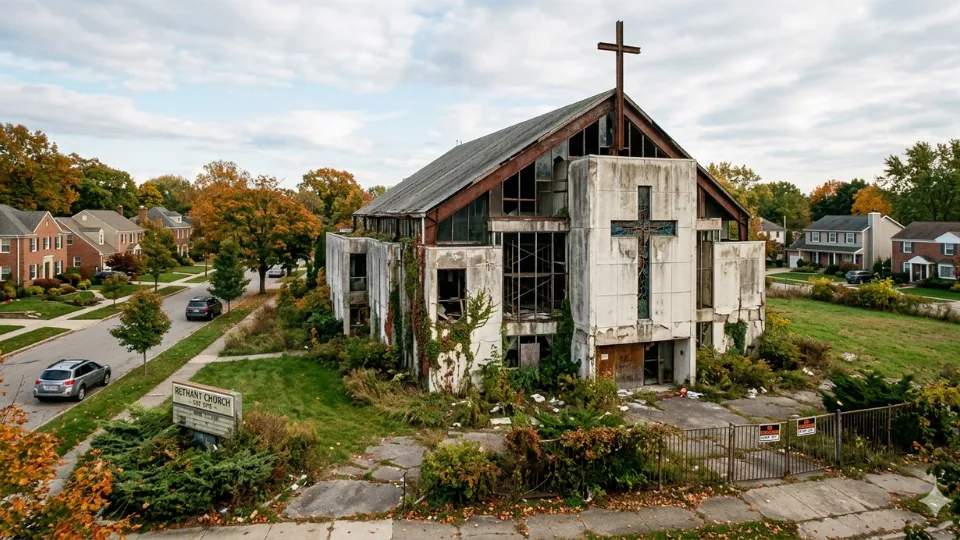
Thirty percent of American congregations may not survive the next twenty years.
That figure comes from research tracking congregational health across denominations and traditions. It is not thirty percent of struggling churches. It is not thirty percent of small congregations already in visible decline. It is thirty percent of churches broadly, including many that look, from the outside, like they are doing reasonably well.
When a number like that circulates in pastoral conversations, it tends to produce one of two responses. Some leaders dismiss it as overstated or inapplicable to their context. Others absorb it as confirmation of a fear they have been carrying quietly. Neither response is quite the right one.
The number is not a verdict. It is a question. And the question it raises is the one most boards have never formally asked.
What is the actual difference between the congregations that will be here in twenty years and the ones that will not?
The Flame That Was Already Burning
The answer is not primarily about theology, preaching quality, or worship style. The research on congregational health consistently points toward something more structural: the financial resilience and institutional adaptability of the organization.
Attendance decline has been real and sustained across most traditions. The post-pandemic attendance floor settled lower than the pre-pandemic baseline in the majority of congregations. The religiously unaffiliated have grown to represent a significant share of the American population. Younger adults are engaging with church differently, less frequently, and with different expectations than their parents did.
These are the flames that were already burning before anything new arrived. They represent the steady, structural erosion of the conditions that allowed a certain kind of church to sustain itself for decades. Congregations financially dependent on a large, stable, aging donor base, with little institutional reserve and no diversification in their income model, were already carrying more fragility than their budgets revealed.
This is the pastoral reality most leaders know from the inside of their own institution. The spreadsheet holds. The ministry continues. But the margin for error has narrowed in ways that are not always visible until something tests it.
The Accelerant Arriving on Top of It
AI-driven economic disruption does not create this fragility. It arrives on top of it. And the question of AI and the future church is not arriving. It is here, already reshaping the economic conditions of the households that fund most church budgets.
The mechanism is direct. A church whose giving base is composed significantly of workers in automation-exposed industries faces real income risk in the households that currently sustain it. As labor displacement moves through those sectors, the financial capacity of a significant share of the congregation shifts. The mission does not change. The money that funded it becomes less predictable.
Current research suggests this disruption will unfold unevenly across communities and sectors. Some congregations will feel it acutely and early. Others may be buffered by the economic profile of their membership. But the congregations least prepared to absorb economic disruption are, in many cases, the same ones already carrying the highest level of structural fragility. The overlap is not coincidental.
What Luke 14 Actually Asks
Jesus's words in Luke 14 are among the most direct in the Gospels about the relationship between intention and preparation. Which of you, wanting to build a tower, does not first sit down and count the cost, to see whether you have enough to complete it? Otherwise, when you have laid a foundation and are not able to finish, all who see it begin to mock, saying this person began to build and was not able to finish.
The tower in that parable is not the building fund. It is the mission. The counting of the cost is not a financial exercise separate from spiritual leadership. It is an expression of it. The leader who refuses to look clearly at whether the institution has what it needs to complete what it has begun is not practicing faith. They are avoiding a question that responsible stewardship requires.
The thirty percent who will not be here in twenty years are not predominantly congregations that lacked faith. They are congregations that built without counting. That did not look clearly at the structural conditions beneath the mission, and so could not address those conditions while there was still time and margin to do so.
What the Congregations That Survive Do Differently
The congregations that will still be here, and still serving their communities with vitality, in twenty years are not necessarily the largest or the most theologically sophisticated. They are the ones that have built enough structural health to navigate what comes.
That structural health includes financial reserves that create real margin for crisis. It includes income diversification that does not depend entirely on employment-based tithing from a single demographic. It includes pastoral care capacity that can meet the needs of members facing economic disruption. And it includes a leadership culture willing to look honestly at the condition of the institution rather than managing the appearance of health.
Visionary Stewardship is the posture that produces that kind of church. It holds faith and wisdom simultaneously. It trusts that God sustains the mission while practicing faithfully building the institutional capacity to carry that mission through seasons of disruption. It does not wait for the crisis to begin the preparation. It builds during the margins, because that is when building is still possible.
The Honest Look Is the First Step
No pastor entered ministry imagining they would be the last one in that pulpit. The longing to leave something that lasts is not vanity. It is the right instinct, properly ordered. The mission is bigger than any one leader's tenure. Preparing the institution to outlast any one season of difficulty is one of the most faithful things a leader can do.
Books like Carey Nieuwhof's AI and the Future Church are beginning to name what church leaders are already sensing about the scale of this shift. The awareness that creates is real and necessary. What it doesn't yet provide is the congregational diagnostic that distinguishes the churches that will navigate what's coming from the ones that won't. That work begins with the honest look at where your institution actually stands, not where it appears to stand, or hopes it stands.
Preparing from Strength, While You Still Have It
Here's the question worth sitting with: what would it take for your church to be among the congregations still here in twenty years, still serving with vitality, still mission-capable in a changed economic landscape?
The answer is not a theological program or a worship pivot. It is structural preparation, done now, while there is still margin to do it from a position of strength rather than desperate reaction.
That preparation begins with clarity. An honest inventory of where the giving actually comes from, what industries those households depend on, where the concentration risks sit, and what reserves exist. Proverbs 27:23 puts it directly: know well the condition of your flocks. You cannot prepare for what you have not honestly assessed.
The churches that are building that kind of structural health now are not the ones operating from fear. They are the ones operating from wisdom. The distinction matters. Fear leads to reactive decisions made under pressure. Wisdom leads to proactive preparation made from strength.
The work of preparation begins with a clear picture of where your church actually stands. Not where you hope it stands. Not where it stood three years ago. Where it stands now, in this economy, with this giving base, against this set of structural pressures. Take the Church AI Readiness Assessment and in 10 minutes you will know where your church stands and what to address first.