Make Your Ministry Irreplaceable: What AI and the Future Church Must Reckon With
by Erin Ward, ChurchReady Co-Founder
Most churches have a Sunday morning problem they haven't named yet. The room fills. The worship is good. The sermon lands. And then people walk out the same door they walked in, alone.
Not unfriendly. Not unhappy. Just alone.
You know this is true. You've watched it. You've probably felt the ache of it. You built something people show up for, and you're watching them leave without the thing they actually need most. That gap, between attendance and genuine belonging, is the pastoral challenge most churches are quietly losing.
It’s also the challenge at the center of what we do at ChurchReady. How AI and the future church collide, and what faithful leaders do about it. That’s the question this organization is built around. And the belonging gap your church is already carrying is part of what makes that collision so urgent.
The Flame That Was Already Burning
Pastoral burnout is real. Volunteer fatigue is real. Attendance pressure, giving pressure, the weight of leading a congregation through a culture that feels less and less oriented toward the Church. All of that is already burning.
And underneath all of it, if you look carefully, is a belonging problem. People are showing up less because they're connected less. Generational transitions are harder because younger adults are less practiced at the kind of slow, friction-filled relational work that real community requires. Small groups are harder to fill because people are more guarded, more tired, and less sure the investment is worth it.
This was already the flame. What arrives on top of it is something that will turn that slow burn into something much more urgent.
AI companion technology is not a future concern. It's a present one. Roughly 72% of teens have already used AI companions, and half use them regularly. One in three teenagers now says they prefer talking to an AI over a real person for serious conversations. What those teenagers practice in private, they carry into every relationship, every small group, every attempt at community you're trying to build.
And it isn't only teenagers. Adults are turning to AI for emotional support, spiritual reflection, and the kind of low-stakes conversation they used to have with neighbors and colleagues. The loneliness epidemic was already well underway before AI gave lonely people a frictionless alternative to human connection.
Scarcity Has Flipped. Is Your Church Paying Attention?
There's a concept worth naming here because it reframes what the Church is actually competing against.
Thirty years ago, content was scarce and community was plentiful. If you wanted to hear biblical teaching, you showed up on Sunday. If you wanted a sense of belonging, your neighborhood, your workplace, your church provided it. The supply of human connection was relatively abundant. The supply of good teaching was not.
That equation has completely reversed. Content is now everywhere. Every sermon, every podcast, every theological question has a thousand answers available in seconds. What's genuinely scarce, what people cannot find with a quick search or a well-crafted prompt, is real community. The kind where someone actually knows your name, remembers what you're carrying, and shows up when things fall apart.
The Church has always been in the business of providing that. But many churches are still operating as though content is the scarce resource, investing in production quality, sermon series, online reach, and social media presence, while the actual gap in people's lives is a belonging gap. A human connection gap. The exact gap the Church is designed to fill.
The question is whether churches will recognize this shift before AI makes it too late to matter.
AI and the Church: Why This Moment Is Structurally Different
Churches have navigated cultural disruption before. The industrial revolution changed where families lived and worked. Television changed how people spent their evenings. Social media changed how people formed identity and community online. The Church adapted. It is still here.
This moment is different in kind, not just in degree. AI is not simply another distraction competing for people's attention. It's a direct substitute for the thing the Church uniquely provides.
When AI can offer personalized spiritual reflection, patient listening, 24-hour availability, and frictionless companionship, people who are already relationally isolated don't just spend less time in community. They start to believe they don't need it. The relational atrophy accelerates quietly, invisibly, until the Sunday morning crowd is even thinner and the people who do show up are even less equipped for the friction that real community requires.
The economic picture compounds this. There's a well-documented trajectory toward significant white-collar job displacement as AI systems take on tasks that have sustained professional careers and consistent household incomes. Whether that displacement happens rapidly or gradually, the effect on congregations is the same: financial pressure, identity disruption, and people searching for meaning, purpose, and a community that will hold them. That's an enormous ministry moment. It's also an enormous pastoral burden, and it will arrive whether your church is ready or not.
Carey Nieuwhof's upcoming book AI and the Future Church is opening this conversation at the level of church leadership. What ChurchReady is focused on is what comes after the conversation opens: the preparation. Because awareness without a plan is just a more informed version of the same unreadiness.
What the Proverbs Says About Paying Attention
Proverbs 27:23 is a verse that doesn't get much pulpit time, but it belongs in this conversation. Know well the condition of your flocks, and give attention to your herds.
It's a charge to the leader: know the actual condition of the people in your care. Not the condition you assume. Not the condition they present on Sunday morning. The actual condition. The isolation they carry home. The relational skills they're quietly losing. The way AI is quietly filling the spaces where human connection used to live.
A pastor who doesn't know that their congregation is already forming habits around AI companions is a pastor who can't lead them through what comes next. Pastoral attentiveness is not a soft skill. It's the prerequisite for everything else. And right now, the condition of the flock includes a belonging deficit that most churches haven't measured, a generational transition away from real community skills that most youth ministries haven't addressed, and a loneliness epidemic that AI is about to make structurally worse.
What the Church Offers That AI Never Will
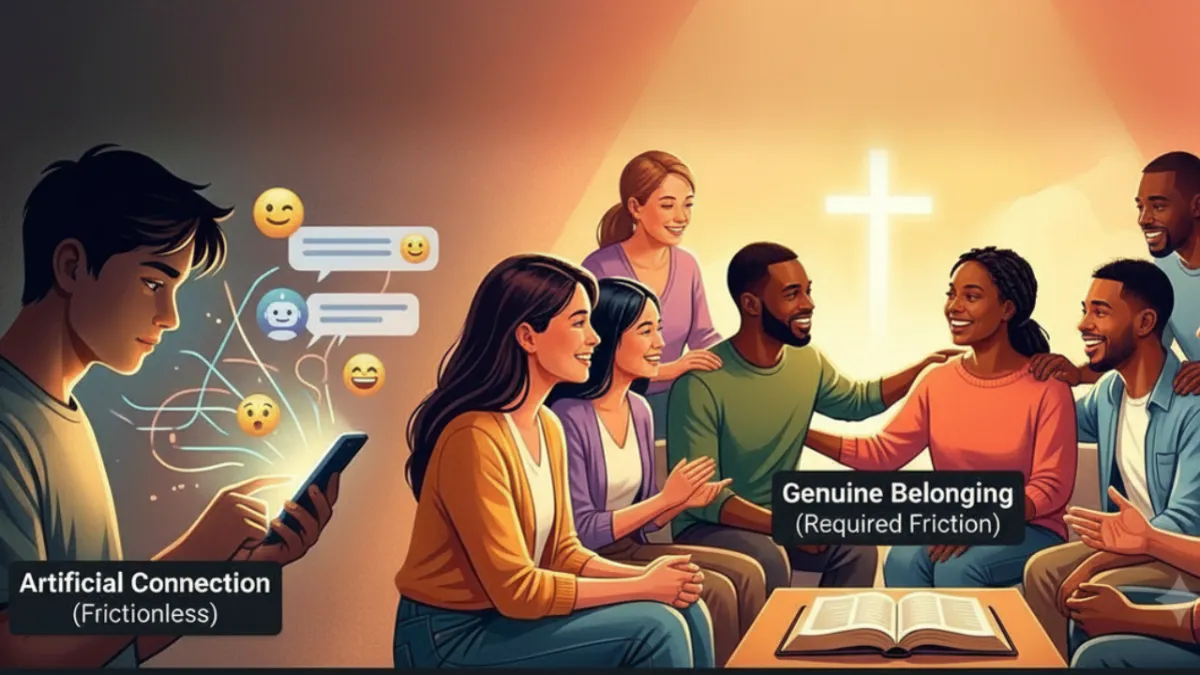
Here's what I keep coming back to: the Church is not in competition with AI. It's in contrast with it.
AI gives endlessly patient responses. The Church gives human presence, messy and imperfect and irreplaceable. AI gives frictionless interaction. The Church gives the kind of community that requires you to show up when it's inconvenient, forgive when it's hard, and be known in ways that can't be optimized away. AI gives confident-sounding answers about God. The Church gives people who have actually been changed by an encounter with God, and who can walk alongside someone else toward that same encounter.
That contrast is not a weakness. It's the Church's entire value proposition in an age of artificial everything.
But contrast only matters if you're positioned to offer it. A church that is so consumed with Sunday morning production, so financially fragile, so relationally thin in its actual community infrastructure, cannot step into the gap that AI is creating. It will watch the gap widen while resources drain and the connection its congregation needed most went unfound.
Faithful stewardship of what this moment requires isn't waiting for the crisis to force your hand. It's building the kind of church, relationally deep, financially stable, pastorally attentive, that can meet people where they're going to be. That's what it looks like to lead with wisdom right now. To prepare in the margins, before the weight of this arrives in full.
The First Step Is Knowing Where You Stand
Your church has something to offer this generation that no technology can replicate. But being needed and being ready are two different things.
If you haven't yet assessed where your church stands on the dimensions that AI disruption is about to pressure most, belonging culture, pastoral care capacity, financial sustainability, community depth, now is the time to look clearly. Take the Church AI Readiness Assessment and in 10 minutes you will know where your church stands and what to address first.