The Giving Model Most Churches Depend On Was Built for a World AI Is Changing
by Erin Ward, ChurchReady CEO | Co-Founder
The conversation about AI and the future church often stays high-level. This one starts in a single church office, with three families who went quietly, financially silent.
There's a pastor in the Southeast who runs a mid-size congregation, maybe four hundred on a Sunday, the kind of church that has been financially stable for twenty years. She knows her donors. She knows which families carry the budget. She knows, without running the numbers, roughly what a difficult quarter looks like versus a genuinely concerning one.
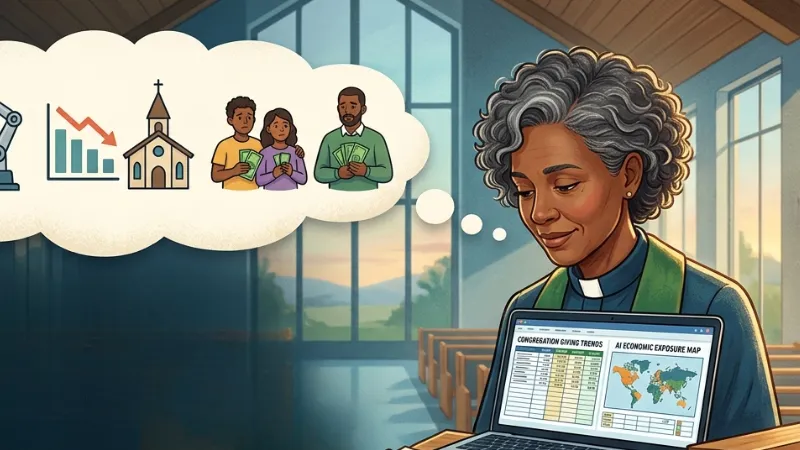
Last spring she started noticing something. Three of her most consistent giving families had gone quiet. Not spiritually quiet. Financially quiet. She didn't ask why at first. She waited. Two of them eventually told her: one husband had been laid off from an accounting firm that had automated his role. Another family's primary income had shifted to contract work after a reorganization. A third was fine but scared, watching colleagues lose positions and holding onto savings as a precaution.
None of them had left the church. All of them were still showing up. The ministry they depended on was contracting in ways that had nothing to do with their faith and everything to do with their income.
She told me she wasn't sure whether she was watching a temporary disruption or a permanent shift. That uncertainty is doing a lot of work in a lot of church offices right now.
The Model That Has Always Run Underneath
The traditional church budget model rests on a simple assumption: that the people who attend will hold stable income from stable employment, and that their generosity will reflect that stability over time. That model has worked reasonably well in periods of economic continuity.
What current economic trajectories are surfacing is that continuity is harder to count on than it used to be. The jobs most immediately affected by AI-driven automation are not on the margins of your congregation. They're in the middle of it. Accounting. Customer service. Middle management. Administrative coordination. Data processing. Legal support. These are exactly the career categories that sustain consistent household giving.
Most churches were not starting from a position of financial abundance even before these pressures arrived. Giving has trended inconsistently across denominations for years. Attendance patterns shifted after the pandemic and haven't fully recovered in many congregations. The gap between ministry ambition and financial reality was already a source of low-grade anxiety in most church offices.
AI-driven economic disruption isn't creating a new financial problem for churches. It's arriving on top of existing pressure. The question isn't whether the pressure will intensify. The question is whether the church is holding enough margin to absorb what's coming without scrambling.
Why AI and the Future Church Budget Conversation Matters Now
Goldman Sachs research estimated that hundreds of millions of jobs globally carry meaningful automation exposure. Let's take a closer look at what that means for the people in your pews. The question of AI and the future church lands here before it lands anywhere else: in the household income of the families who currently sustain your ministry.
To be precise: no one knows the exact pace of this shift. The trajectory is visible; the timeline is not. Some displacement will happen gradually, creating adjustment time. Some sectors will see it faster. What a church can control isn't the trajectory. What a church can control is whether it's prepared across multiple possible scenarios, or fully exposed to a single one.
The recent encyclical from Pope Leo XIV named it plainly, noting that in some contexts there is a legitimate fear of a significant and rapid contraction in available jobs that would create a chain reaction deeply impacting families, young people, and local economies. That chain reaction reaches church budgets. It's already beginning to, in the quiet way those three families in that Southeast congregation demonstrated last spring.
What Active Stewardship Looks Like
Joseph didn't start building when the famine arrived. He analyzed Egypt's existing capacity, optimized a system during the years of abundance, and maximized what was there so that when the lean years arrived, the mission of preservation could be carried out with strength rather than desperation. That's not anxiety. That's the form faithful stewardship takes when the leader is paying attention to what God has shown them about what's coming.
The Parable of the Talents makes the same point in a different register. The servant who buried what he was given wasn't punished for making bad investments. He was condemned for doing nothing. Passive maintenance isn't faithfulness. Active stewardship of what God has entrusted, including the financial infrastructure of the local church, is the expected posture.
Reactive responses to budget pressure (cutting staff, suspending programs, drawing down reserves at the worst possible moment) aren't failures of faith. They're failures of preparation. And they happen to churches that were never given the tools to think ahead.
The Question She Couldn't Answer
Here's the question we should ask. The pastor in the Southeast who watched three families go financially quiet wasn't operating from bad theology or bad leadership. She was operating without the picture she needed.
She didn't know what industries her top giving households worked in. She didn't know what share of her giving base was concentrated in automation-exposed sectors. She didn't know what a 15 percent reduction in consistent giving would mean for her staffing model. She knew the people. She didn't know the exposure.
You see, that gap isn't a character flaw. It's a structural one. And it's the gap that Visionary Stewardship is specifically designed to close, before the pressure makes closing it an emergency rather than a choice.
Carey Nieuwhof's AI and the Future Church is opening a conversation that church leaders need to be inside. The financial thread is one of the most practically urgent dimensions of that conversation. The awareness it creates is necessary. What follows the awareness is where ChurchReady operates: the concrete work of mapping your exposure, assessing your margin, and building toward the kind of structural resilience that keeps the mission funded whatever economic scenario arrives.
Preparing While Preparation Is Still Possible
Visionary Stewardship in this context means taking an honest look at the income structure of your church before the pressure forces your hand. It means understanding which households carry disproportionate weight in your giving base, what industries they work in, and what the exposure looks like if those industries shift. It means asking what it would take to build greater diversification, both in income streams and in the breadth of giving participation.
This isn't crisis management. It's preparation from a position of strength, while you still have the capacity to prepare well.
Now, before we go further: this isn't about predicting the future. It's about building the kind of institutional health that serves the mission across multiple possible futures. The churches that will sustain their ministry through what's coming aren't the ones with the most accurate economic forecasts. They're the ones that built resilience while the margin existed to do it thoughtfully.
You Don't Need All the Answers. You Need a Clear Picture.
The first move is knowing where you actually stand. What's your giving concentration? What industries does your tithe base depend on? What would a meaningful reduction in consistent giving mean for your current operations?
The Church Resilience Assessment surfaces that picture. It's free, takes less than ten minutes, and gives your leadership team the honest baseline every Visionary Steward needs before they can build from strength rather than react from pressure.