When Nobody Believes the Same Thing: AI, the Future Church, and the Pastor's Prophetic Voice
by Erin Ward, ChurchReady Co-Founder
The conversation about AI and the future church usually runs through money and ministry models. This one runs through something more fragile: whether your congregation can still agree on what's real.
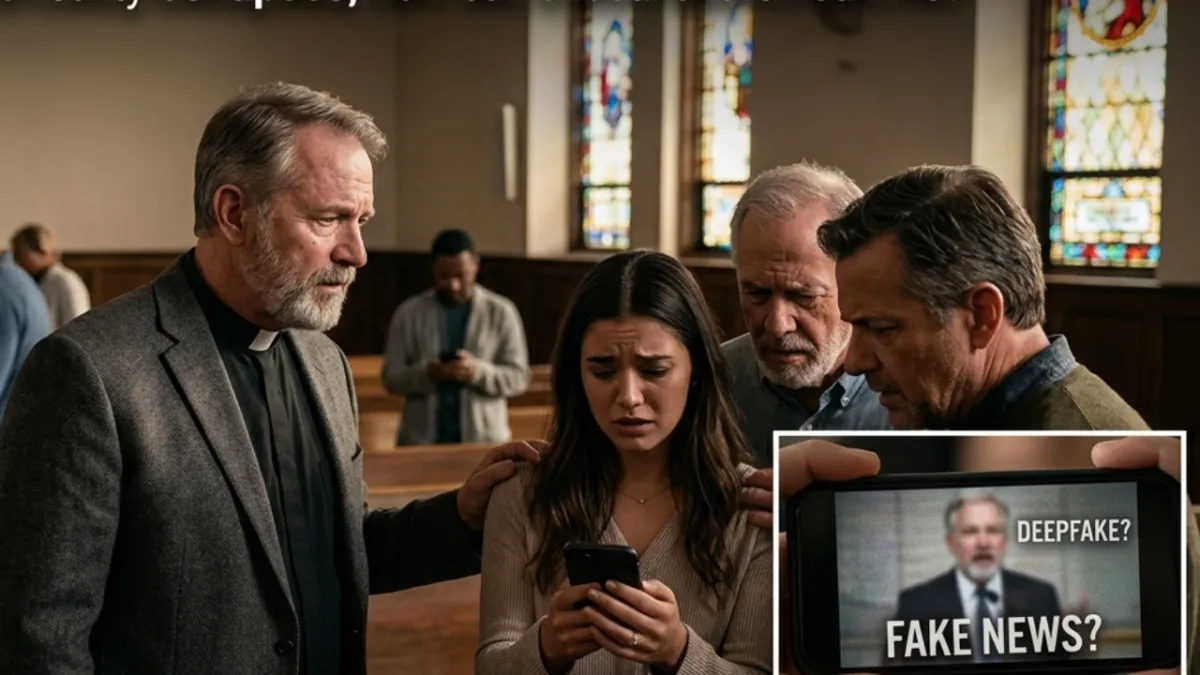
Deepfake technology now makes it possible to produce video and audio of real people saying things they never said. Not crude imitations. Convincing ones. Research on media literacy suggests most adults can't reliably identify AI-generated media without specific training. A video of a leader, a pastor, a public figure saying something inflammatory is no longer proof they said it. It's evidence that someone produced it.
That shift isn't abstract. It arrives in your congregation's group chats. It circulates in the apps your congregants trust. It surfaces in the conversations that happen between Sunday services, in the hours when you're not in the room. And when people bring those conversations with them on Sunday morning, they carry the emotional weight of what they believe they saw and heard. Conflict doesn't wait for verification.
The recent encyclical from Pope Leo XIV addressed this directly, noting that AI does not merely transmit information but shapes culture, and that those who control digital platforms possess a significant ability to affect the collective imagination and present a particular vision of reality as desirable. That's not a distant concern for media scholars. It's a pastoral emergency for anyone leading a local church.
What Gets Eroded When Reality Fractures
There's a term for what happens to communities when shared reality collapses: social trust. And when social trust erodes, the institutions that depend on it start to struggle. Churches depend on it more than almost any other institution, because the church's work is relational at its core. The question of AI and the future church runs through this before it runs through any financial metric. Discipleship requires shared understanding. Pastoral authority requires that the people in your care believe you're operating from honest engagement with the world. Generosity requires confidence in shared purpose.
When congregants can no longer agree on what's real, trust calcifies into factions. The pastor caught between them doesn't get the benefit of the doubt anymore. Whatever they say gets interpreted through the lens of which faction they're perceived to favor. That's an exhausting place to lead from, and a lot of pastors are already there.
The flame here predates AI. But the accelerant is arriving with speed.
What the Church Has That AI Does Not
Let's take a closer look at something worth saying clearly: the church has been in the truth business for two thousand years. Christian discipleship has always included discernment as a practice, the practiced capacity to evaluate what is true, to sit with a text and wrestle with what it means rather than accepting the first available interpretation. The Bereans searched the Scriptures daily to see whether what they were hearing was accurate (Acts 17:11). That posture, that slow, humble, communal engagement with truth, isn't outdated. It's exactly what the current moment requires.
The church offers something AI can't provide: a community committed to truth that is also committed to each other. That combination is rarer than it sounds. It's not enough to want the truth. You have to want it alongside people you've covenanted to stay with even when it's uncomfortable. That's what makes a church different from an information channel.
The congregation that practices discernment together doesn't disappear into separate reality tunnels. It becomes a place of genuine grounding in a world where grounding is hard to find.
What Visionary Stewardship Looks Like Here
Here's the question we should ask. This isn't the kind of problem that resolves itself. Pastors who aren't actively leading into it are already losing ground to it by default.
Visionary Stewardship holds faith and wisdom at the same time. In this context, that means trusting that the truth of the Gospel isn't threatened by deepfakes or algorithmic noise, while also doing the practical, wise work of equipping your congregation to navigate an environment that's actively hostile to shared reality. One without the other is incomplete.
That work begins with honest assessment. It begins with knowing where your congregation actually is: what they're watching, what they believe about the information they consume, how much space exists for disagreement before trust breaks down. It continues with deliberate investment in discernment as a community practice, not a one-time sermon series but an ongoing posture built into how you practice discipleship together.
The Pastoral Authority That Holds
You see, the pastors who navigate this well aren't the ones who become the most credible information sources. They're the ones who become the most trusted truth-seeking companions. There's a difference.
A credible information source competes with every other information source. A trusted companion leads people toward wisdom that information alone can't produce. The pastor who has built that kind of relational authority, through sustained presence, honest engagement, and a demonstrated commitment to truth over comfort, is not threatened by AI's entry into the information landscape. They're clarified by it.
What distinguishes them is not superior content. It's the kind of relationship that makes discernment possible. And that relationship is built over time, through exactly the kind of consistent, costly presence that Visionary Stewardship is designed to protect and sustain.
Carey Nieuwhof's AI and the Future Church is raising the right questions about what pastoral leadership needs to look like in a world reshaped by AI. The truth and discernment dimension is one of the most practically urgent threads in that conversation. It's not a future problem. It's arriving in your congregation's group chats this week.
The Preparation Worth Making
The church that builds discernment capacity now, in the window before the full weight of AI-driven information disruption arrives, is the church that will have something to offer when the people around it are drowning in noise. That's a preparation worth making.
It means investing in theological literacy that goes deeper than content familiarity. It means building small group cultures where the practice of sitting with hard questions together becomes normal. It means protecting the pastoral time and presence that makes genuine relationship possible, which requires the kind of operational health Visionary Stewardship is designed to build.
Proverbs 22:3 puts it directly: the wise see danger and take refuge. The danger here isn't dramatic or sudden. It's a slow erosion of the conditions that make pastoral authority, shared community, and genuine discernment possible. The wise pastor sees that erosion and builds against it, now, while the capacity to build still exists.
See Where You Stand Before You Plan
Leading well through a shifting authority landscape begins with an honest picture of your current state: how your congregation is receiving and processing information, where pastoral relationships are genuinely deep, and where the operational gaps are that limit your capacity for the kind of presence that builds trust.
The Church AI Readiness Assessment surfaces the dimensions of your church's health that determine whether pastoral authority strengthens or erodes in the season ahead.