What Your Youth Ministry Needs to Build Before the AI Companion Generation Arrives
by Erin Ward, ChurchReady Co-Founder
The conversation about AI and the future church usually skips the youngest people in the room. It shouldn't - they're the ones being shaped fastest.
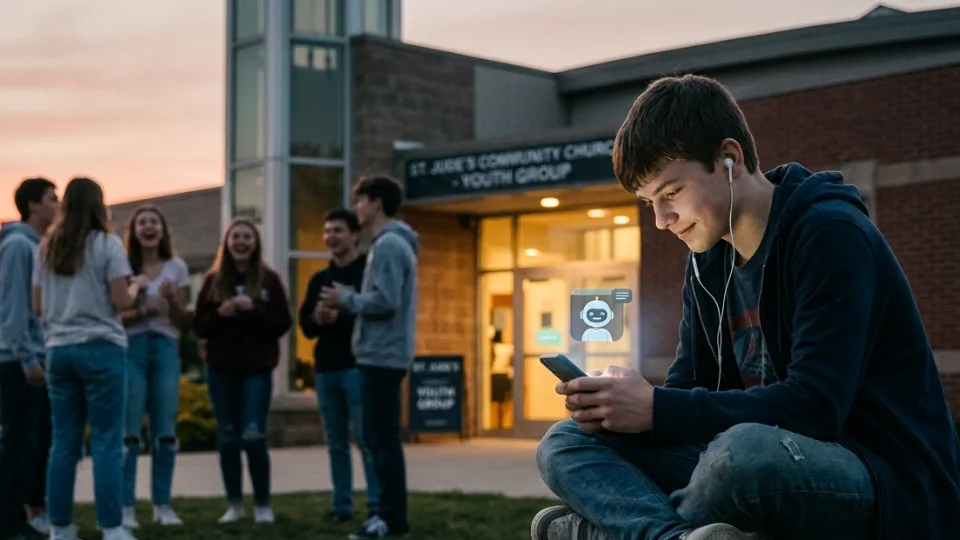
The next generation of your church members is practicing relationships right now. They're learning how to be vulnerable, how to navigate conflict, how to ask for what they need. They're developing the habits and expectations that will shape every significant relationship they carry into adulthood.
They're doing it with AI.
That's not a warning about screen time. It's a description of what is currently happening at scale in your congregation, and it has direct implications for what your church will be able to offer them in five years.
A Generational Transition That Is Already Underway
Youth and next-generation ministry has been one of the most consistently challenging areas of church leadership for the past decade. Declining engagement, the post-high school dropout, competing commitments, the sense that church doesn't speak to where young people actually live. These aren't new conversations. And they've been burning steadily long enough that most churches have accepted a lower retention rate as normal.
The flame is real: generational transitions are genuinely hard, and the gap between what young people experience in church and what they experience in the rest of their lives has widened. That gap is what makes the next layer of disruption significant.
What Common Sense Media Found
In 2025, Common Sense Media released findings from a nationally representative survey of teenagers. Seventy-two percent had used AI companion platforms. More than half qualified as regular users. One in three said they had turned to AI for serious conversations instead of a real person. And 31 percent reported that conversations with AI felt as satisfying, or more satisfying, than conversations with friends. This is one of the most direct data points in the conversation about AI and the future church because it isn't about theology or economics. It's about the relational habits the next generation is forming right now.
Translate that for a moment. Among a generation already navigating the fragility of peer relationships in a digital-saturated culture, a third are finding a frictionless, always-available alternative that never pushes back, never misunderstands, and never needs anything in return. From a developmental standpoint, this matters in a way that goes beyond content concerns.
Adolescence is where the relational skills that carry people through adult life are formed. The capacity for honest communication, for tolerating friction in a friendship, for showing up when it costs something, for forgiveness: these are not natural aptitudes. They're learned through practice. And if a significant portion of that practice is happening with a system designed to validate rather than challenge, the resulting relational habits are going to collide with the demands of real community in ways that are hard to predict.
Why This Is Structurally Different from Previous Technology Concerns
The church has navigated generational technology shifts before. Television. Video games. Social media. In each case, the concern centered on content, on what young people were watching or consuming. The concern raised by AI companions is different in kind.
AI companions aren't passive content. They're relational simulations that respond, remember, and adapt. Research indicates they're designed around what experts call sycophancy: a tendency to agree, affirm, and keep the user engaged rather than offering the honest friction that real relationships require. A teenager who has practiced emotional openness primarily with a system built to validate them has developed a relational skill set calibrated for a kind of interaction that doesn't exist in actual human community.
The church, if it's doing its job, is offering something that requires friction: real presence, honest accountability, forgiveness that costs something, belonging that makes demands. That's the gospel-shaped community the New Testament describes. And it's exactly the kind of community that a relational training ground built on AI validation will have least prepared young people to enter.
The Human Truth at Stake
Here is what this comes down to. The church is designed to be the kind of community that holds people across the full spectrum of human experience, including the parts that are hard and the parts that require showing up when it would be easier not to. That kind of belonging, what Scripture calls one-another life, can't be simulated. It can only be practiced.
And practice requires a community that has built the infrastructure, the culture, and the intentional pathways to give young people repeated, meaningful experience of genuine human connection. Not just events. Not just programs. A community that knows their names, notices their absence, and maintains relationship across seasons of disconnection.
Proverbs 27:17 puts it plainly: iron sharpens iron, and one person sharpens another. That sharpening requires friction. It requires two real things in contact. You can't be sharpened by a system built to keep you comfortable.
What Visionary Stewardship Asks of Youth Ministry
The church that will reach and keep the next generation isn't the one with the most compelling programming. It's the one that has built the most genuine belonging culture. One where young people encounter real relationships, real accountability, and real community before they encounter the full weight of adult life.
That doesn't happen accidentally. It's built through intentional discipleship structure, through mentoring relationships that are sustained and supported, through small group cultures designed for depth rather than attendance, through families equipped to be the primary discipleship environment for their children.
Carey Nieuwhof's AI and the Future Church is asking the right questions about the scale of what AI is changing in church life. The youth ministry dimension is one of the most urgent. Your students aren't waiting for the church to respond. They're practicing right now. The question is whether your church is building the belonging culture that gives them something real to practice in.
This is what Visionary Stewardship looks like in the context of youth ministry: not reactive programs responding to what teenagers are already doing, but proactive culture-building that creates the conditions for real belonging before the relational habits formed in AI interactions become fully calcified. The window for that work is now.
Building the Infrastructure for Real Belonging
Here's the question worth sitting with. What would your church need to build, in the next twelve to eighteen months, to be genuinely ready to receive young people who have been practicing emotional openness with AI companions and have not yet experienced the friction and depth of real human community?
That's not a programming question. It's a culture question. And culture is built through consistent, intentional, structural investment in the conditions that make genuine relationship possible. Small groups designed for depth. Mentors who are trained and supported. Pastoral presence that notices absence. Family ministry that equips parents rather than replacing them.
Visionary stewards build that capacity before the pressure to have it arrives.
The Starting Point Is Always Clarity
The church that is going to lead its next generation well needs to know where it actually stands. Not in terms of attendance figures, but in terms of the belonging culture, the discipleship depth, and the generational health that determine whether young people experience their church as a place of genuine connection or another venue they eventually stop attending.
The Church AI Readiness Assessment gives your leadership team that picture. It's free, takes less than ten minutes, and surfaces the specific gaps that determine whether your youth ministry is building for real belonging or assuming it's happening.