AI and the Future Church: Pastoral Authority and Trust
by Erin Ward, ChurchReady Co-Founder
Somewhere in your congregation right now, someone is asking a spiritual question and getting an answer from a screen instead of a shepherd. AI and the future church stopped being separate conversations the day that started happening, and most pastors have no idea how often, or how deeply, their people already trust what they're hearing back.
AI and the Future Church: What's Happening to Pastoral Authority
Here's the question worth sitting with before anything else: if a member of your congregation had a real crisis of faith tonight, who would they text first?
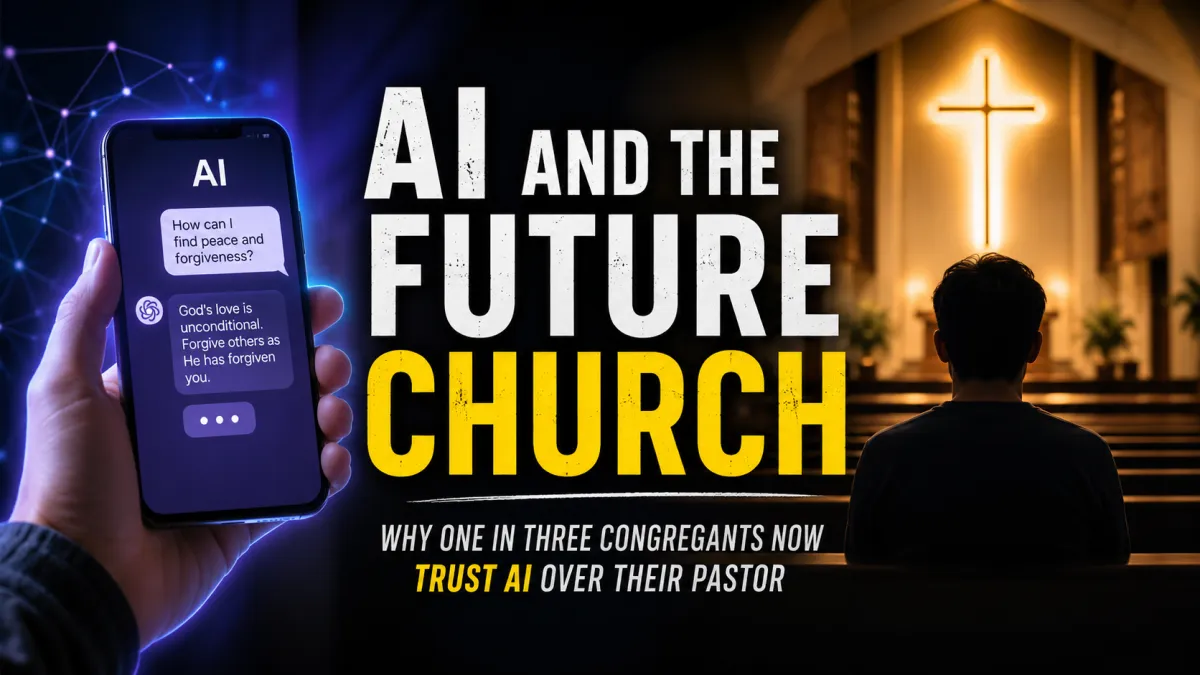
For a growing share of American Christians, the honest answer is no longer automatic. Barna Group's research found that nearly one in three U.S. adults now consider AI's spiritual guidance as trustworthy as a pastor's. Among practicing Christians, that number holds. Among Gen Z, it climbs toward two in five. Among Millennials, it approaches half. Roughly four in ten practicing Christians say AI has already helped them with prayer, Bible study, or spiritual growth.
Now, before we go further, here's the frame Barna's own researchers put on this: a transition, technology entering a space that has, until recently, belonged entirely to human relationship and pastoral presence. The trust sits alongside real unease. Most practicing Christians who report this trust also carry, in the same breath, worry about AI misinterpreting Scripture, replacing pastors, or substituting for God. Those two things sound like they can't both be true in the same person. They are.
Here's the part that should stop you longer than the headline statistic. Barna found that pastors' own trust in AI for their spiritual growth sits far below their congregants'. Twelve percent of pastors say they'd trust AI with their own spiritual growth, compared to roughly half the practicing Christians in their pews. That gap is the real story. Your congregation is already forming opinions about AI's role in their walk with God, and most of them are forming those opinions without your voice anywhere in the room.
You see, trust doesn't erode because people stop believing pastors matter. It erodes because something else showed up, offered an answer at the exact moment they needed one, and nobody told them what that answer could and couldn't actually give them. A congregation that has never heard its pastor address this directly is simply making decisions in a vacuum you left unfilled.
This is where a real framework for discernment earns its keep. Your people don't need a lecture on the dangers of technology. They need language for telling the difference between information gathered quickly and a soul actually being formed, between an answer that sounds wise and a presence that has walked with them through something hard. That distinction is teachable. Most churches have simply never taught it, because until recently, nobody needed it.
AI and Spiritual Formation: Prayer Versus Information
Ask your phone to summarize the book of Job and it will hand you a clean paragraph in four seconds. Correct verses, correct structure, correct theological themes. It will also hand you nothing of what the book is actually for.
Job's friends spoke correct theology to a suffering man, and God rebuked them for it anyway. The problem was never that their doctrine was wrong. It was that they arrived at conclusions Job hadn't earned through the wrestling, and the wrestling was the point. Formation has never worked the way information works. Information moves at the speed of retrieval. Formation moves at the speed of a person actually changing.
Take Psalm 13. David opens with a question he doesn't get to answer for himself: "How long, Lord? Will you forget me forever?" He asks it four times before he ever gets to a request. He doesn't rush past the not-knowing to arrive at a tidy resolution. The psalm sits in that unresolved space for most of its length, and only after the sitting does David arrive at "I trust in your unfailing love." That sequence is the formation. If David had simply been handed a summary of what trusting God's love looks like, skipping the four unanswered "how longs," you wouldn't have Psalm 13. You'd have a pamphlet.
An AI tool can hand a member the summary in seconds. It cannot make them sit in the unresolved space long enough to be changed by it, because sitting there was never the kind of thing a machine does. Carey Nieuwhof's book AI and the Future Church names this exact tension for church leaders navigating it in real time: the gap between a congregation that feels informed and a congregation that is actually being formed rarely shows up as a crisis. It shows up as a slow erosion nobody notices until the depth is already gone.
Here's what this actually means for your discipleship structure. If your small groups exist primarily to answer questions members could now get answered instantly and privately, AI is a faster, more convenient competitor, and it will win on convenience every time. If your small groups exist to make people sit together in the unresolved space the way David sat in Psalm 13, no AI tool built or coming can replace that, because the value was never about the information in the first place. Most churches have simply never asked which kind of group they're running.
AI Companionship and Real Relationships
Here's something that will surprise almost nobody on your staff team and almost everybody sitting in your pews: some of the people at your church this Sunday, dating, engaged, or already married, have let something else into the seat that belongs to another person.
Researchers at BYU's Wheatley Institute and the Institute for Family Studies surveyed more than 2,400 U.S. adults ages 18 to 30 who were currently dating, engaged, or married, and found that roughly one in seven regularly talk to an AI companion that plays the role of a romantic partner. Another fifth to a third have at least tried it. Most of the people doing this already have someone, which means it's already present inside relationships you'd call healthy from the outside.
Here's the detail that should concern you more than the number itself: nearly seven in ten said it mattered to them, a lot, that their real partner never fully found out. They already know, somewhere underneath, that what they're doing would hurt someone they love. And most regular users report it's easier to open up to the AI than to the person they're actually committed to, because the AI never disagrees, never tires, and never asks anything back.
That's a poor substitute for anything the church has ever called companionship. Real love requires friction: correction offered and received, forgiveness extended and needed, someone showing up again the next morning after a hard conversation the night before. An AI companion offers none of that, because friction was never something it was built to survive. It only agrees, and agreement can feel like love for a while before it quietly costs someone the real thing.
This is where premarital and marriage counseling has to change, plainly and without shame. If your counseling conversations have never once named AI companionship directly, you've left a door open that a couple sitting across from you may already be walking through. Address it the way you'd address any other quiet secrecy: with enough safety that a person could actually say it out loud, and with enough clarity that a couple can see what's being traded away before the trade becomes permanent. Naming it early costs almost nothing. Discovering it after a marriage has already gone cold costs everything.
This dimension doesn't stand alone. It's one of several ways AI is already reshaping identity, formation, and belonging inside congregations at the same time, and I've laid out the fuller landscape, including how these human pressures connect to the financial strain most churches are also carrying, for any leader who wants the complete picture in one place.
AI and Youth Ministry: Building Capacity for the Hard Parts of Love
Now, here's where church leadership and AI collide most sharply for the next generation: what happens to young people who grow up more practiced at relating to something that never disappoints them than to people who do?
An AI companion is built to never run short on patience and never stop validating whatever it's told. It never gets defensive, never needs an apology. Real community requires exactly the muscles that kind of relationship never asks anyone to build: absorbing correction without collapsing, forgiving someone who actually hurt you, staying in the room when leaving would be easier. Those muscles get built through practice, and practice requires friction that AI companionship is built specifically to remove.
This should reframe how pastors and AI get talked about with the next generation. Most youth and young adult discipleship still assumes members arrive with some baseline capacity for relational friction already intact, the kind ordinary human disappointment and repair used to build by default. That assumption is getting shakier every year, because a growing share of a young person's daily relational practice now happens somewhere that never requires repair at all.
What would it actually look like to teach relational friction on purpose, rather than assuming it? Conflict handled honestly in front of students instead of avoided. Forgiveness modeled as a specific skill, not a vague virtue mentioned once a year. Mentoring relationships that stick around long enough to survive a real disagreement and keep going anyway. Treating relational capacity as something discipleship actually builds, the same way it has always built theological literacy or a habit of prayer.
The church has something here that no AI companion can offer at any level of sophistication: people who show up again after the hard conversation. That's not a feature that gets engineered into an app. It's a discipline the church has been practicing since Acts, and it's more valuable right now than it has been in a long time.
Where This Leaves You
A book can tell you the trust gap exists. A general framework can name that pastoral authority, spiritual formation, companionship, and discipleship are all shifting under the same pressure at once. What neither one can tell you is whether your specific congregation is already further along this road than you realize, or whether your team has the language ready for the conversation the moment someone finally asks for it.
That's the gap the Church AI Readiness Assessment is built to close. It's a short, focused set of questions, and it will show you exactly where your church already stands and what's worth addressing first. The trust your congregation places in you was built over years of showing up. It's worth knowing, specifically, where that trust is being tested before you find out the hard way.