Church AI Readiness Demands a Holistic Response
by Erin Ward, ChurchReady Co-Founder
The Pressure Every Church Is Already Carrying
When we consult with churches on AI readiness, one question keeps coming up: “What does church AI readiness actually mean for my church?” Here is my answer: it means artificial intelligence is already reshaping the job market your congregation depends on as well as their lives and faith. The real question is whether your church is ready for what AI is changing on multiple fronts at once.
This is a real challenge for many churches we work with because they usually pick one lane to go after. Some have gone hard after the budget: tightening operations to build margin. Others have gone hard after the people: adding counseling capacity, building community, deepening pastoral care. Both instincts are good. Both are also incomplete on their own.
Why AI Disruption and the Church Move Together, Not Apart
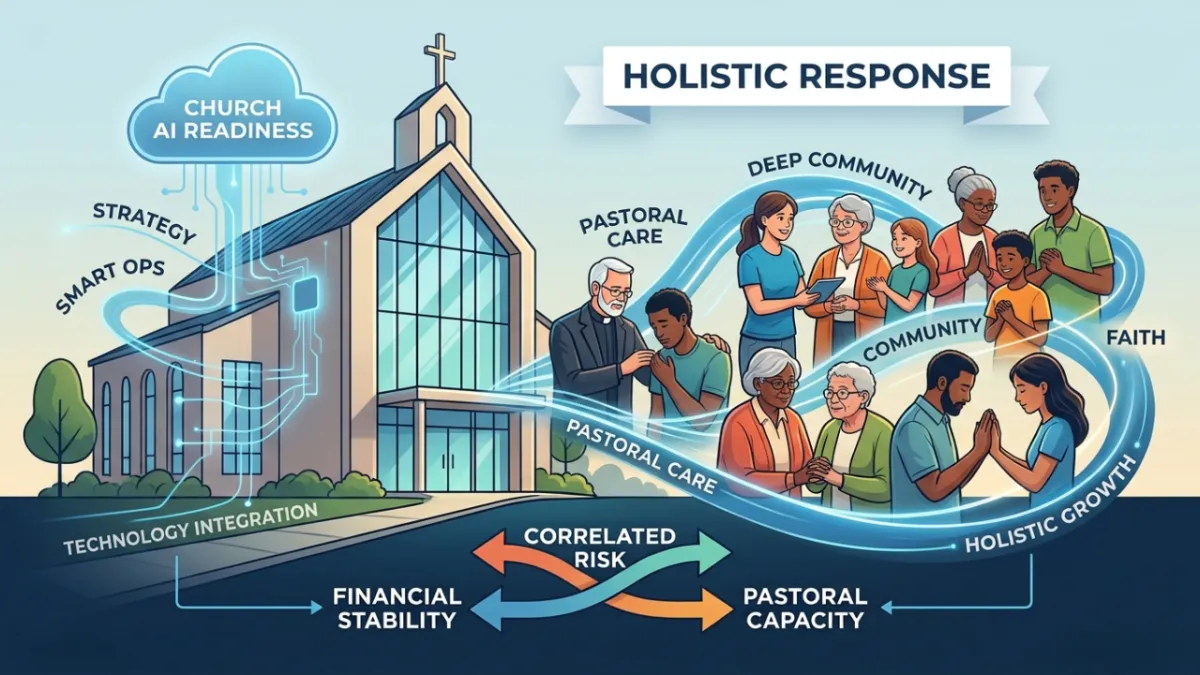
This is why a half response can be costly. A church that shores up its budget while pastoral capacity stays flat eventually finds itself financially stable and pastorally overwhelmed. A church that builds rich community while its financial runway erodes eventually finds itself full of people it deeply cares about and unable to fund the care they need. Both churches are fully exposed. They’re just exposed on different sides of the same storm.
This is what we call correlated risk. Correlated risks move together because they share a common cause. AI's impact on your church behaves like correlated risk. The giving decline, the counseling surge, the strain on belonging, and the erosion of pastoral authority as a trusted voice are four readings of the same storm, not four independent problems that happen to be occurring at the same time.
This understanding allows us to help pastors reframe what church AI readiness actually requires. Readiness for independent risks means covering your bases one at a time. Readiness for correlated risk means building infrastructure that holds all fronts together, because that is how AI disruption actually arrives.
How AI Job Loss Is Reaching Church Giving
Churches have weathered economic pressure before. Recessions come and go. Generations shift how they give and how they show up, and being a church leader has taught me that. What is different this time is that the labor market is shifting shape across administrative, customer service, and mid-level roles that overlap heavily with the income brackets sustaining most tithe-based budgets.
This could unfold gradually, as retraining and new roles absorb some of the disruption, or more quickly, if adoption outpaces the labor market's ability to adjust. Both scenarios move the financial and pastoral fronts together. A gradual disruption still produces a slow leak in giving alongside a slow rise in people needing care. A rapid one produces both faster. That is the trajectory church AI readiness has to be built for.
What Survives: Church Readiness and AI as One Response
What survives a shock like this is a posture: the discipline of faithful stewardship of everything God has entrusted to a church, its money and its people, its systems and its relationships, with the same future-oriented attention rather than favoring one side over the other.
The churches we work with understand their mission does not change because of AI. So our first step is to help them get clarity on whether they have enough margin to keep pursuing that mission. It starts with visibility into a church's full current state, strengthens what is already working, and extends both financial footing and pastoral capacity together, so neither is left to catch up later.
Where Church AI Readiness Starts
In a world growing more artificial each day, people will become extremely hungry for hope, for unchanging truth, and for genuine community, which means your church has never been more needed.
This is a great opportunity for your church, but being needed and being ready are two different things. If you have not yet considered how AI disruptions are reshaping church budgets and the lives and faith of the people in the pews, clarity before action is the right place to start.
We've written more fully about this in our guide to AI and the future church, and it is worth reading if you want the full landscape before narrowing in on your own church's picture.
Books like Carey Nieuwhof's AI and the Future Church are part of why this conversation about both the promise and the pressure AI brings is finally reaching church leadership at a greater scale. Naming AI’s impact on the church and the lives and faith of believers is the necessary first step. The next step for churches is getting clarity about their AI readiness status, and the Church AI Readiness Assessment will do just that. In about ten minutes, it will show you where your church stands.