AI and the Future Church: Calculate Your Financial Exposure
by Erin Ward, ChurchReady Co-Founder
Your giving report will lie to you, and it won't know it's doing it. Giving is one of the last numbers to move when a household's income gets shaky. A family trims eating out first, then subscriptions, then vacations. The tithe often holds until there's genuinely nothing left to give. Which means the chart your finance committee reviews every month can look calm for a season after real pressure has already arrived in someone's living room.
That's the actual question behind AI and the future church, at least on the financial side: whether your leadership team would know, with real specificity, before your giving numbers started sliding.
AI and Church Giving Exposure
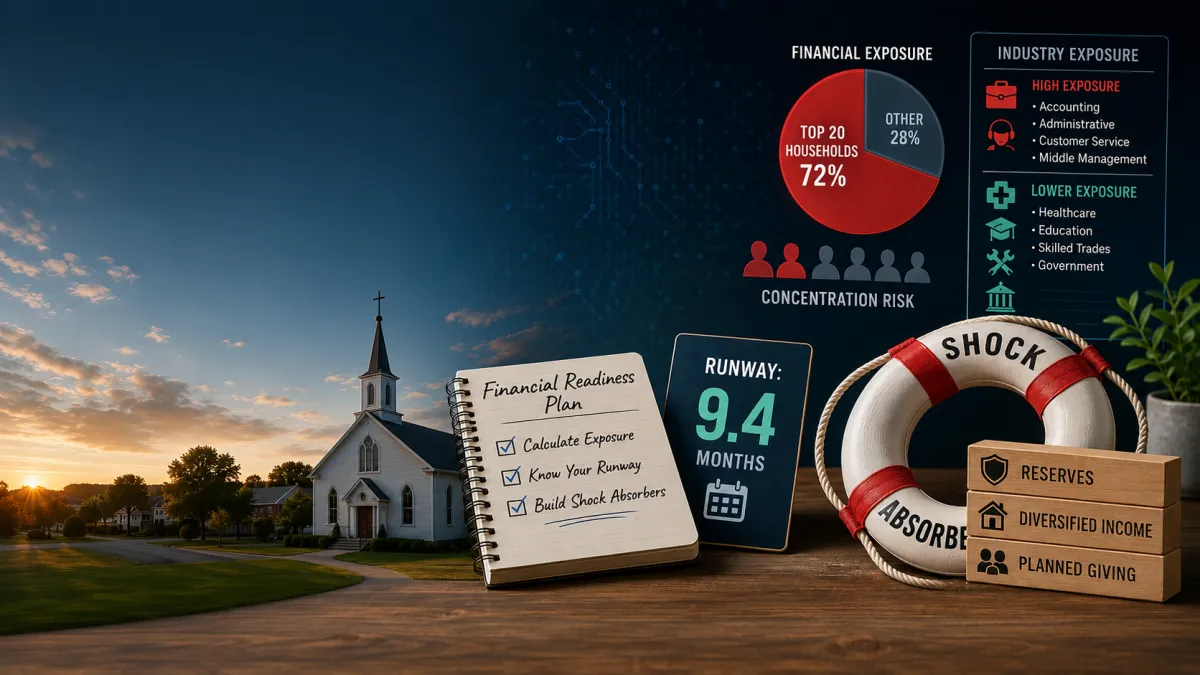
Every church leadership team should know one number before any other: what percentage of total giving comes from the top twenty households. Most don't. Giving in the average congregation follows something close to the familiar pattern where a small share of givers carries a large share of the budget. That concentration is a risk on its own, and it existed years before anyone was talking about automation. What AI-driven job displacement adds is a plausible trigger for a vulnerability most churches were already carrying.
AI and church giving are connected by something more specific than a general economic mood. They're connected through which industries actually fund your budget. Income from contract or gig work can swing by 30 to 50 percent month to month, which breaks the predictable, salary-based rhythm most tithing patterns depend on. And the careers most exposed to near-term automation, accounting, administrative work, customer service, and middle management, sit squarely inside the income brackets that sustain consistent giving in most congregations. Healthcare and several other sectors continue to grow through the same period. A congregation whose giving leans heavily into the contracting sectors is carrying a different risk profile than one spread evenly across a dozen industries, and most leadership teams currently have no way of knowing which profile describes them.
Mapping AI and church budget exposure starts with the same twenty households, viewed through a different lens: which of those givers work in roles a downturn would hit first, before it ever shows up in their giving. You likely already know some of this from conversation. You're filling gaps, not starting from zero. Pair that with a short, anonymous survey across the wider congregation asking what sector people work in, no names or figures attached. Set the two lists side by side. If a meaningful share of your budget traces back to roles current research identifies as highly exposed, you've found something worth planning around. If your giving is already spread across healthcare, education, skilled trades, and government work, you've found something worth naming to your board as a genuine strength.
AI Disruption and Church Budget Knowledge: Trend vs. Exposure
Knowing that AI is reshaping the labor market is not the same as knowing what would happen to your church if giving dropped 30 percent over six months. The first is a trend. Anyone reading the news can tell you the trend is real. The second is exposure, and exposure is the number that actually changes what a leadership team decides to do this quarter.
Most churches have never calculated their own runway: how many months they could sustain full operations if income fell sharply. That gap is understandable. The number has simply never been asked for before, because the slow, gradual giving erosion most churches plan around rarely forces the question. A sudden, broad-based drop is a different kind of event, and it deserves a different kind of preparation.
The math itself is straightforward. Take your total annual operating expenses and divide by twelve. That's your monthly burn rate. Take your current cash reserves and divide by that burn rate. That's your runway, expressed in months. Most finance committees can pull both figures from an existing report in an afternoon. The work isn't gathering data you don't have. It's asking a question you haven't asked yet.
Once you have that number, build a tiered response instead of a single doomsday plan. What changes at a 10 percent drop in income? Probably very little. Maybe a line item gets deferred. What changes at 25 percent? Now you're likely looking at program cuts, and you should know which programs before the pressure arrives, not during a board meeting where everyone is guessing under stress. What changes at 50 percent? That's the tier that forces conversations about staffing and facilities, and it's far better to have that conversation calmly in a season of stability than for the first time while the shortfall is already happening. Writing this tiered plan now costs you an afternoon. Writing it for the first time in the middle of a crisis costs you weeks you don't have, and it usually produces worse decisions.
That tiered plan is what church financial readiness for AI actually looks like in practice: a spreadsheet with real numbers in it, sized to your own congregation, sitting in a drawer ready to be pulled out instead of built from scratch under pressure.
AI Shock Absorbers for Your Church
Carey Nieuwhof makes this case directly in AI and the Future Church: churches need something functioning like a financial shock absorber, margin built before the impact rather than scrambled together after it. That's the right instinct, and it's worth taking further than a single chapter can take it.
A real shock absorber goes further than a reserve account with a number sitting in it. A reserve that exists on paper but was never sized against your actual exposure will feel solid right up until the moment it isn't. The reserve that matters is the one built from the runway math above, sized to your church's real giving concentration, not to a generic rule of thumb borrowed from a nonprofit conference. Conversations about church resilience and AI tend to stop at the reserve account. The more useful version goes one level deeper: sizing that reserve to your actual exposure instead of a generic guess.
Reserves are only one layer. The deeper work is reducing how much of your total budget depends on a single source in the first place. That can mean building rental income from underused space, pursuing grants aligned with your actual mission, or growing a planned giving program so a small, real share of your congregation has included the church in their estate planning. These sit alongside Sunday giving rather than replacing it, so no single disruption, AI-driven or otherwise, can threaten the whole budget at once.
This is where the calculation from the previous section stops being an exercise and starts being useful. The tiered plan you built for a 10, 25, and 50 percent drop isn't only a defensive document. It's also a map of exactly where new income needs to land first if you want to make the hardest tier less likely to arrive at all.
There's an old story worth reaching for here, and it earns the reference. Joseph didn't wait for the famine to start storing grain. He built the system during the seven years when Egypt had more than enough, and he built it by managing what Egypt already had well, not by inventing something from nothing. That's the same posture this work asks of a leadership team: analyze what you're already bringing in, put a real number on your exposure, and build margin while you still have room to build it thoughtfully instead of urgently. Margin like that changes what a budget conversation is even for. It stops being about defending what you already have and starts being about funding the ministry only your church can do. We've written more about what that shift requires of a pastor here. The margin isn't just protection. It's what lets a church say yes to a family in crisis without checking the budget first.
A book can tell you that churches need shock absorbers, and Carey was right to say it. A spreadsheet template can help you estimate what a generic reserve target might look like for a congregation your size. Both resources still have real value. They serve a different purpose than the diagnostic this stage of the work actually requires: which two or three households in your specific congregation represent a disproportionate share of your risk, and what your actual runway is once your actual numbers are in front of you.
That specific, church-by-church picture is what the Church AI Readiness Assessment is built to surface. It takes about ten minutes, and it shows you where your own congregation's exposure sits, not where exposure sits in general. If you haven't run the numbers in this piece for your own church yet, that's the place to start. Pick one number today: your current burn rate. You can have it before the end of the week.